
1. Which organelle would be abundant in?
a) Skeletal muscle
- Secretion of useful substances
- Formation of secretory vesicles
b) Palisade cell
2. State the functions of the following organelles.
a) Lysosomes
b) Golgi apparatus
c) Ribosomes cell
3. Name the organelles that perform each of the following functions in a cell.
a) Protein synthesis
b) Transport cell secretions
4. The diagram below represents a cell.
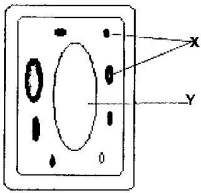
a) Name the parts labelled x and y
- X- chloroplasts
- Y- Vacuole
b) Suggest why the structures labelled x would be more on one side than the other side.
In dim light, they move to the upper part of the cell in order to receive enough sunlight for photosynthesis
5. a) State the function of cristae in mitochondria (1mk)
-Increase surface area for attachment of respiratory enzymes hence increasing rate of respiration.
b) The diagram below represents a cell organelle
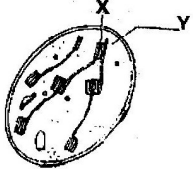
(i) Name the part labelled Y (1mk)
-Stroma
(ii) State the function of the part labelled X (2 mks)
-Absorb sunlight used for light stage of photosynthesis
6. a) What is the formula for calculating linear magnification of a specimen when using a hand lens? (1mk)
b) Give a reason why staining is necessary when preparing specimens for observation under the microscope. (1mk)
-To make the features clearer and distinguishable
7. State three functions of Golgi apparatus. (3mks)
-Transport secretions to the cell surface for secretion e.g. enzymes and mucus.
- They form lysosomes
8. Name two structures found in plant cell but are absent in animal cell.
9. Write the role of the following parts of a microscope
i) Nerve cell
ii) Palisade cell
iii) Root hair cel
iv) Red blood cell
10. The diameter field of view of a light microscopic is 3.5mm. Plant cells lying of the diameter are 10. Determine the size of one cell microns (1mm = 1000μm
11. Define the following
i) Tissue
ii) Organ
iii) Organ system