
1. (a) How does a sea breeze occur? ( 2 mks)
•During the day the land heats faster than the sea.
• The air over the land rises
• Cooler air from the sea blows towards the land to replace the rising air
• The cool air from the sea is called sea breeze
(b) Use the map of Africa below to answer questions (b) (i)
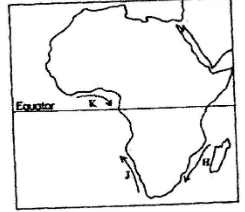
(i) Name the ocean currents marked H, J, and K (3 mks)
H- Mozambique,
J - Benguera
(ii) State two effects of a warm ocean current on the adjacent coastlands (2 mks)
•Raising temperature Causes rainfall
(b) Name four layers of the earth’s atmosphere (4 mks)
• Troposphere
• Stratosphere
• Mesosphere
• Ionosphere
3. (a) State two conditions that are necessary for the formation of fog.
• Air must have abundant moisture.
• A cloudless night to facilitate terrestrial radiation.
• Air should be calm to remain in contact with the ground in order to be cooled.
• There should be gentle air currents to hold water droplets in suspension.
• The air must be cooled below dew point.
(b) The diagram below shows some types of clouds. Use it to answer the questions that follow.
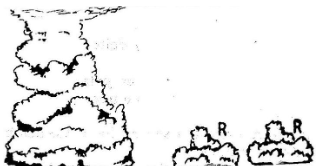
(i) Name the clouds marked R
R - cumulus.
4. a) The tables below represent rainfall and temperature of stations X and Y. Use them to answer questions (a) and (b)
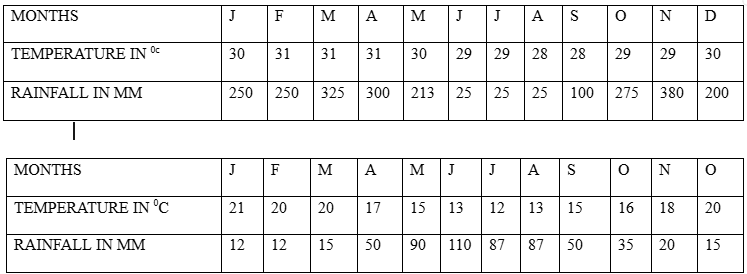
a) (i) For each of the two stations calculate the mean annual temperature.
X - 3°C
Y - 9°C
(ii) Calculate the annual rainfall for station Y
583 mm
• Sea makes water is heated intensely by solar radiation.
• Heating is intense in the afternoon
• Warm moisture laden air rises and condenses at higher altitude.
• Condensed water vapour forms cumulonimbus clouds.
• Clouds eventually give rain accompanied by thunderstorm.
(iii) On the graph paper provided, draw a bar graph to represent rainfall for station x. Use vertical scale of 1cm to represent 50mm
b) Describe the climatic characteristics of station Y.
5. a) The table below shows climatic data of a station in Kenya. Use it to answer question (a)

i) What is the annual range of temperature at the station?
30.3 - 28.4 =1.9°C
ii) Calculate the total rainfall for the station.
9.0 + 8.0 + 21.0 + 49.0 + 25.0 + 9.0 + 20.0+10.0 + 4.0+10.0+17.0+11.0 =1930 mm
b) State three factors that influence climate.
• Altitude - High altitude areas have low temperature and low pressure. Temperature varies with height because air is heated from below.
• Winds transfer heat from one place to another causing changes in temperature.
• Latitude influences climate such that areas near equator are warmer.
• Aspect influences climate as south facing slopes in the northern hemisphere are warmer than north facing slopes in the same.
• ITCZ- zone of low pressure which migrates North and South equator affects rainfall.
6. (a) Name two elements of weather that can be recorded at a school weather station
• Sunshine
• Rainfall
• Wind
• Cloud cover
• Air pressure
• Humidity
7. (a) Describe a suitable site where you would locate a weather station in your School (2 mks)
• Open area free of shade by trees and buildings.
• Gentle land free of flooding
• Area with wide view of surroundings.
• Away from concrete surfaces.
(b) Give reasons why a Stevenson’s screen is:
• Painted white - can reflect direct heat from the sun.
• Louvred on sides - To allow free flow of air and regulate temperature.
8. Define relative humidity. (2 mks)
Relative humidity refers to the ratio between water vapour actually present in the air and its capacity to hold water vapour at a given temperature.
9. (a) Identify four characteristics of convectional rainfall. (4mks)
• It's heavy and torrential/falls in large drops.
• Usually accompanied by lighting and thunderstorms
• Falls mainly in the late afternoon
• It's highly localized and lasts for a short while (15-20 mins)
(b) State the difference between radiation fog and advection fog. (4mks)
•Radiation fog forms when air in contact with the ground is cooled through terrestrial radiation while advection fog forms when warm moist air is cooled as it passes over cool surface e.g. land/sea.
10. (a) Briefly describe how the six thermometers operate. (5mks)
• When the temperature rises, the alcohol in the left hand column expands and pushed the mercury column. The mercury in turn pushes the mercury in the right hand column and steel metal index up.
• The maximum temperature is shown by the end of the index pushed by the mercury.
• When the temperature falls, alcohol in the left hand column contracts and pulls the index along the tube. When the temperature rises, the alcohol expands leaving behind the index. Then the minimum temperature is read.
(b) Three ways in which clouds are classified. (3mks)
• According to the altitude of their bases.
• Their appearance/structure
• Their formation
- It should be in an open place with free flow of air.
11. (a) Give three precautions to be taken when citing a weather station. (3mks)
- Away from barrier e.g. trees - Should be on a fairly level ground.
- The site should be free from flooding
- The site should provide a wide view of the surrounding landscape and the sky.
(b) State three factors determining the amount of solar radiation reaching the earth's surface. (3mks)
• Intensity of the sun's radiation in space the average distance from the sun.
• The transparency of the atmosphere
• Position of the earth in its orbit
• The area and nature of the surface on which the rays fall.
12. Define the following terms:
(i) Climate
Climate It's the average weather condition of a given place over a period or time usually (30-35 years)
(ii) Relative humidity
Relative humidity Refers to the ratio between water vapour actually present in the air and its maximum capacity to hold water vapour at a given temperature.
(iii) Weather forecasting
Weather forecasting it’s the prediction of the weather situation for a given place within a given period of time e.g. hour, a day, a week.
(iv) Absolute humidity
Absolute humidity It is the total amount of water vapour that a given volume of air can -hold.
(v) Weather lore (5mks)
Weather lore Refers to a body of traditional facts and beliefs relating to weather e.g. a halo around the moon, croaking of frogs, a rainbow, migration of birds
13. State the advantages of studying weather through field work. (5mks)
• The students are able to relate what they have learnt in class to the real environment hence making geography real and interesting. • It breaks the class monotony.
• It enables learners to develop skills or observation measurement, recording and analyzing data.
• It improves the visual memory through observation.
14. (a) Describe how you would use the following apparatus during a field study.
Rainfall, maximum and minimum thermometers. (3mks)
i. Rain gauge
• The rain gauge is kept in an open space in the weather station from above.
•Its raised to avoid splashes from entering into the gauge.
• The water collected is emptied into the measuring cylinder every 24hrs.
• Take readings on the measuring cylinder.
• This cylinder is graduated in mm and the level the water emptied reaches gives us the reading amount of rainfall for the day.
• Record the readings and interpret.
ii. A maximum and minimum thermometer
• When the temperature rises, alcohol in the left hand column expands and pushes the mercury column and maximum temperature is read.
• When the temperature rises, alcohol in the left hand column contracts and pulls the index along the tube and the minimum temperature is read from the upper end of the index.
• After recording the reading, the thermometer is reset using a magnet.
• Interpret the readings.
(b) Identify and explain the formation of the type of rainfall found in the Lake Region or Kenya. (8mks)
Convectional rainfall Its formation
• The intense heating from the sun results into warm air rising in form of convectional currents.
• The rising air reaches the high atmosphere and moisture in it condenses. Forms clouds and falls rain.
• It falls in the late afternoon accompanied lighting and thunderstorms.
(c) Briefly write down two problems associated with the type of rainfall above. (4mks)
• Lightening and thunderstorms which are destructive to life and property.
• The torrential/large drops which are harmful to the crops and other vegetation.
• The hailstones also are destructive to the crop leaves.
15. (a) What is weather forecasting? (2mks)
• Weather forecasting is the prediction of weather conditions
(b) List four problems of weather forecasting. (4mks)
• Inaccurate data
• Defective instruments
• Personnel with limited skills
• Vagaries of nature such as earthquakes
(c) State four ways in which weather forecasting is important to the human activities. (4mks)
• Determines times for sea and air travel.
• Determine time when sporting activities take place.
• Determines the fishing activities and habits in the area.
• Help determine suitable clothing for the day.
• Help plan farmers calendar of activities.
• Help plan suitable housing.
16. (a) Explain three ways in which clouds influence weather. (3mks)
• Clouds determine the amount of solar radiation reaching the earth's surface and the amount leaving the earth's surface. This determines temperature conditions.
• Day temperatures are moderated by clouds.
• Areas of thick rain clouds have high rainfall.
(b) Use the data below to answer questions that follow. (10 mks)

(i) Calculate mean annual temperature
Mean temperature -276/12 = 23°c
(ii) Calculate annual rainfall
(Annual rainfall 1073 mm
(iii) Calculate annual range of temperature.
Annual range of temperature 5°C
(iv) Calculate the mean annual rainfall
Mean rainfall - 1073 mm
(v) Which is the wettest month?
Wettest month - April
17. (a) Define 3 air mass. (2mks)
•Large volume of air with uniform temperature and humidity and flow over considerable distance
(b) Name types of air masses. (3mks)
•Equatorial air mass
• Tropical air masses
• Polar air masses
• Arctic and Antarctic air masses
(c) A mass of air at 15°C can hold 20gm/cm3 of moisture. The same air at the same temperature has 6gm/cm3 of moisture. What is its relative humidity? (4mks)
15° - 20g/cm3
6g/cm3 =?
RH = A.H x 100%
= 6/20 x 100= 30%
18. Name two instruments placed in the Stevenson Screen. (2mks)
•A thermometer/ maximum/ minimum/ six thermometer
•Hygrometer/wet and dry bulb thermometer.
19. Why does sea breeze flow at nighttime? (3mks)
• At night, land loses heat faster than sea.
• Air upon land becomes cooler and heavier than that upon the sea.
• The relatively warmer air upon the sea is lighter and therefore it rises while the cooler heavier air at the land flows towards the sea to replace the warm rising air.